
The stakes
Moving money means reporting on everyone you pay.
Every payee type carries a different return
Card and third-party network volume carries 1099-K. Contractors, gig workers, and freelancers carry 1099-NEC and 1099-MISC. US-source income paid to non-US persons carries 1042-S with withholding. One payment ledger has to feed all of them.
A year-end batch job cannot keep up
Payments settle every second, and a process that runs once a year cannot absorb that. Reconciling huge files in Q4 stops being an option.
W-8 and W-9 at the front door
You need each payee's tax status settled before a single form is filed. Collecting and checking W-8s and W-9s at onboarding keeps filing clean and avoids per-record penalties.
Payee counts that keep growing
What you have to report grows with every market and payout rail you add. The system has to take on more payees and more regimes without a new build each time.
By business model
Payments is four businesses, and the reporting differs.
If you operate the rails themselves, this usually isn't your obligation. Card networks, ACH, SEPA, and their blockchain equivalents sit underneath the firms transacting over them, and the reporting sits with those firms.
Payment processors
Authorization, clearing, and settlement across card networks, banks, and wallets. 1099-K attaches to card and third-party network volume.
Payout providers
Mass payouts to sellers, contractors, and gig workers, often across several rails at once. Every payee needs a tax status before they're paid, and different payee types carry different returns.
Global money transfer
Cross-border remittance over SWIFT, ACH, and blockchain rails, with currency conversion and local payout methods. With payees outside the US, 1042-S and withholding come in.
The difference
Real-time data in. Filed reports out.
The old way
- A year-end batch process that buckles under real-time volume
- W-8 and W-9 collection bolted on outside the payment flow
- A separate vendor or spreadsheet for each form and each jurisdiction
- Reconciling huge files days before the deadline, by hand
With Taxbit
- Payment data loaded in real time, not reconciled at year-end
- W-8 and W-9 collected and validated at onboarding, inside your flow
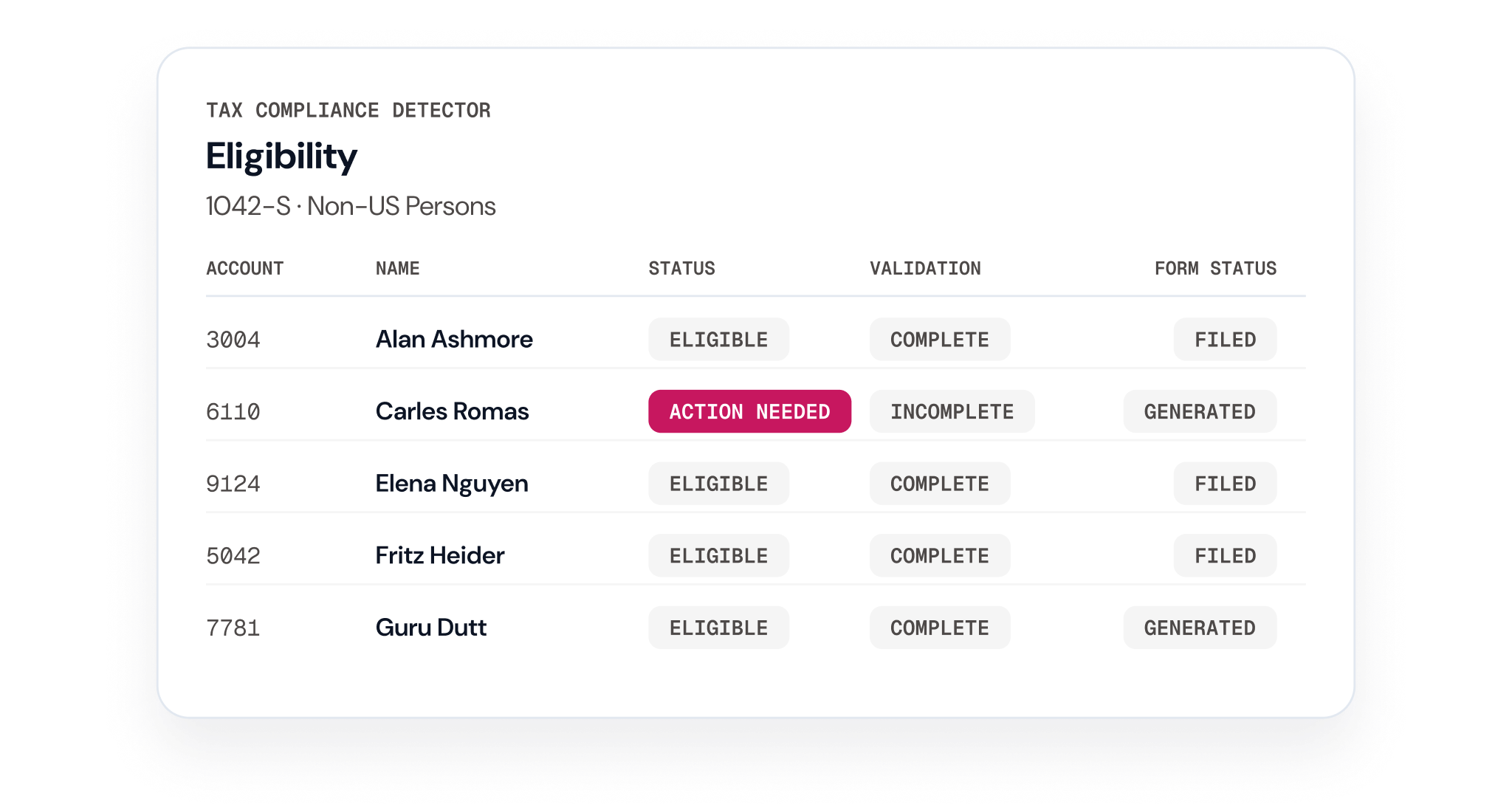
- 1099-K, NEC, and MISC, plus 1042-S, generated from the same payment data
- Withholding status carried on the payee record, visible before a form is filed
The standard our customers hold us to.
“We wanted to bring users crypto with all the trust and safety PayPal is known for. Taxbit helped us fulfill our commitment to the highest standards for compliance.”
Edwin Aoki · CTO, Blockchain, Crypto, & Digital Currencies, PayPal
AI you can put in front of a regulator
Rules written into the system make the call on every account, and your team can read them. Every action the AI proposes is reviewed by a person before it runs.
A full audit trail
Every gain and loss traces back to the transactions behind it.
Your data stays yours
Taxbit does not train AI models on your data, and nothing is sent to third-party AI vendors.
SOC 2 and enterprise controls
The security documentation your team asks for before a deal closes, ready for review.
Payments reporting, answered.
Enough to know each payee's tax status before the first reportable payment: a W-9 for US persons, a W-8 for foreign persons and entities, and a CARF or CRS 2.0 self-certification where those regimes apply. Taxbit collects it through an SDK that runs inside your own product, so the payee never leaves your flow. US TINs are matched against the IRS in real time, foreign tax IDs and VAT numbers are validated by format, and status is monitored after onboarding in case it changes.
The paperwork, the checks, and the form owed at the end of the year all change depending on where a payee sits, even though every payment comes out of the same ledger. Taxbit collects and checks W-9 and W-8 in the flow you already use to onboard payees, keeps withholding status on the payee record, and generates 1099 and 1042-S from the same payment data. A mixed payee base runs through one system instead of two.
It depends on what the payment is for. Payments settled over payment cards and third-party networks carry 1099-K. Payments to contractors, gig workers, and other non-employees carry 1099-NEC. Rents, royalties, and other income carry 1099-MISC. US-source income paid to non-US persons carries 1042-S with withholding rather than a 1099. Taxbit works out which return each payee needs and generates all of them from the same source data.
Potentially several, and they are different in kind. CESOP covers cross-border payment data rather than income reporting, so it sits apart from the 1099 series and is worth scoping separately. CRS 2.0 can apply where you hold electronic money balances for customers, with no digital assets involved. Which regimes you fall under is your determination and your counsel's. Taxbit takes the ones you report on and makes them operational, from the payment and account data you already send us.