


A B-Notice is what a payer sends a payee after the IRS issues a CP2100 or CP2100A notice, flagging a payee name and taxpayer identification number that don't match IRS records. Every affected account has to be found, notified, and resolved.
Upload
Upload your CP2100 file and select the tax year. Processing starts immediately.
Analyze
Every record is matched against your account data with flags on exactly who requires a B-Notice.
The correct packet goes to each recipient based on notice type, without printing a page or stuffing an envelope.
Resolve
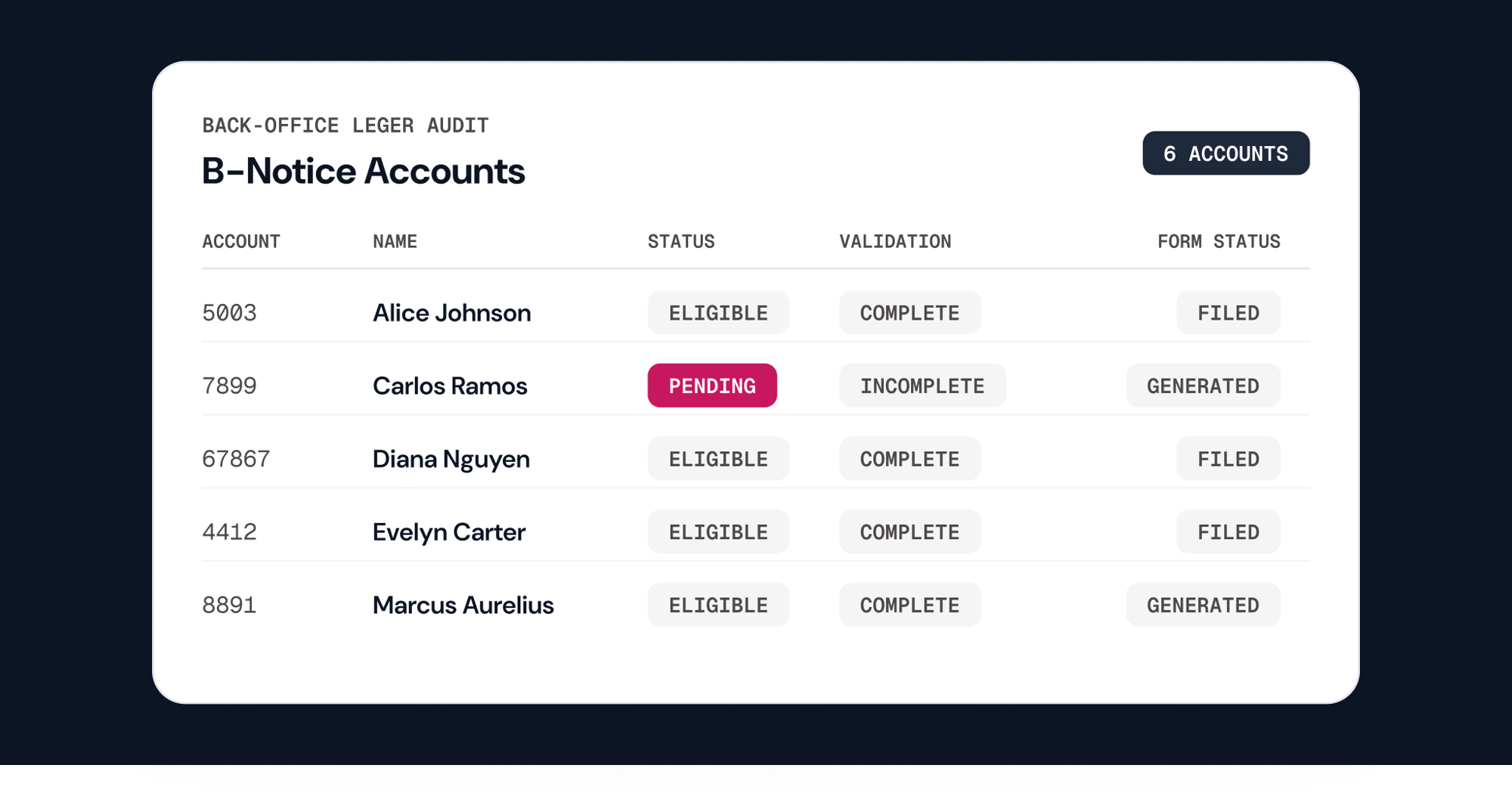
Track status across your population and resolve notices as documentation comes in.
A CP2100 or CP2100A is the notice the IRS sends a payer when a payee name and taxpayer identification number (TIN) on a return you already filed do not match IRS records. It lists every affected account, and it requires the payer to send each of those payees a B-Notice. The IRS issues them on a twice-yearly cycle, in April and October.
A first B-Notice and a second B-Notice arise in different circumstances and carry different requirements, so IRS procedure calls for a different response to each. Taxbit checks three years of notice history on every determination to assign the correct type and send the matching packet, rather than working them as a single queue.
Backup withholding is a portion of a payment that the payer keeps back and sends to the IRS instead of paying it to the payee. An unresolved name and TIN mismatch from a CP2100 notice is one of the things that can require a payer to start withholding on that payee's future payments.
No. Taxbit surfaces the accounts that require withholding and facilitates the process around it, including backup withholding tied to unresolved B-Notices and 1042-S withholding for foreign payees. Calculating who requires withholding and tracking it on the account record is Taxbit's job; withholding and remitting the funds stays with the payer.
Each record matched to the right account, the correct packet mailed, and follow-up tracked.