
Every form you owe, filed right, in the jurisdictions you report in.
Nothing handed back
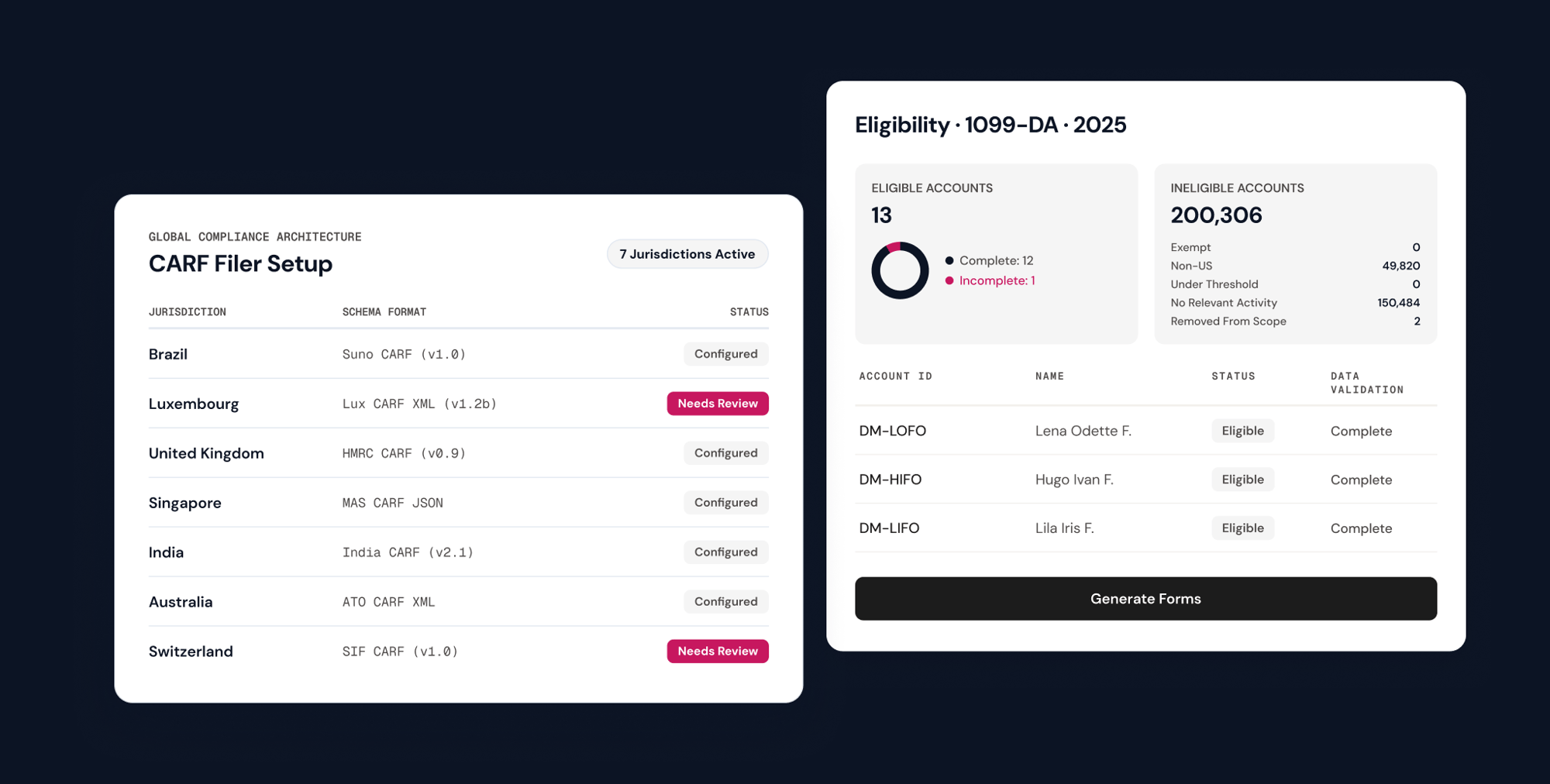
Every form is generated, validated, filed, and delivered from one system of record.
One set of source data
Self-certifications and W-8s collected at onboarding decide who is reportable, so international filings run off the same records as US ones.
Format changes are configuration
When a jurisdiction revises its schema late in the year, Taxbit updates configuration and keeps filing.
US reporting and international reporting.
01
US Information Reporting
The full 1099 series, Form 1042-S, Form 1042, and gain and loss statements, filed with the IRS and the states, with recipient copies delivered to your customers. Corrections and B-Notices are worked in the same system after filing.
02
AEOI Reporting
03
MRDP Reporting
Zero Hash delivered 65k+ forms 100% on time, with a 95.4% TIN match rate.
"Taxbit's shared commitment to building trusted infrastructure, combined with their deep tax expertise… gives us confidence that jointly we will deliver for our customers and regulators."
Edward Woodford · CEO & Founder, Zero Hash

Information reporting and withholding, answered.
Tax documentation collection is gathering and validating the forms that establish a customer's tax identity and status at the moment their account opens: W-9 for US persons, W-8 for foreign persons and entities, and CARF or CRS 2.0 self-certification for crypto-asset reporting. Taxbit collects it through an SDK embedded in your own product, then validates, monitors, and stores it, so the record is ready before the first reportable transaction happens.
A missing or incorrect document doesn't stay contained to onboarding. It becomes a wrong filing, then a correction, then a notice, and the fines land on whoever filed it. Collecting and validating documentation at account opening is what keeps that chain from starting.
CARF self-certification is the account-opening step where a customer declares their tax residency and status for reporting under the OECD's Crypto-Asset Reporting Framework and the amended Common Reporting Standard, CRS 2.0. Taxbit collects it through the same embedded flow as W-9 and W-8. Collection has been live for all new customer accounts since January 1, 2026, and Wave 1 jurisdictions file Tax Year 2026 XMLs in 2027.
Your customer is prompted for a W-9, W-8, or self-certification inside your product, not redirected to a separate site. The form arrives pre-filled from the data you already hold, including your KYC record, so they confirm what is there and certify their TIN instead of entering it again. The account then moves into a "we're reviewing your account" state while Taxbit validates it. None of it leaves your product.
Taxbit validates, monitors, and stores it, and verifies US and foreign tax IDs automatically for new and existing customers. Every account gets a status: valid, invalid, needs action, or missing. It flags issues like needs resubmission, US indicia, or a treaty country mismatch, and tracks W-8 expiration and changes in a customer's circumstances. Each record shows which document it is, W-9, W-8BEN, W-8BEN-E, W-8IMY, or self-certification, and when it was last submitted.