

We started with the hardest version of the problem.
Exchanges, brokers, and stablecoin off-ramps with transaction history fragmented across every wallet and venue. Taxbit started there in 2018, filed the first 1099-DA season with zero misses, and runs the same reporting for CARF, CRS 2.0, and DAC8 as brokers expand into the EU, UK, and Asia.
The stakes
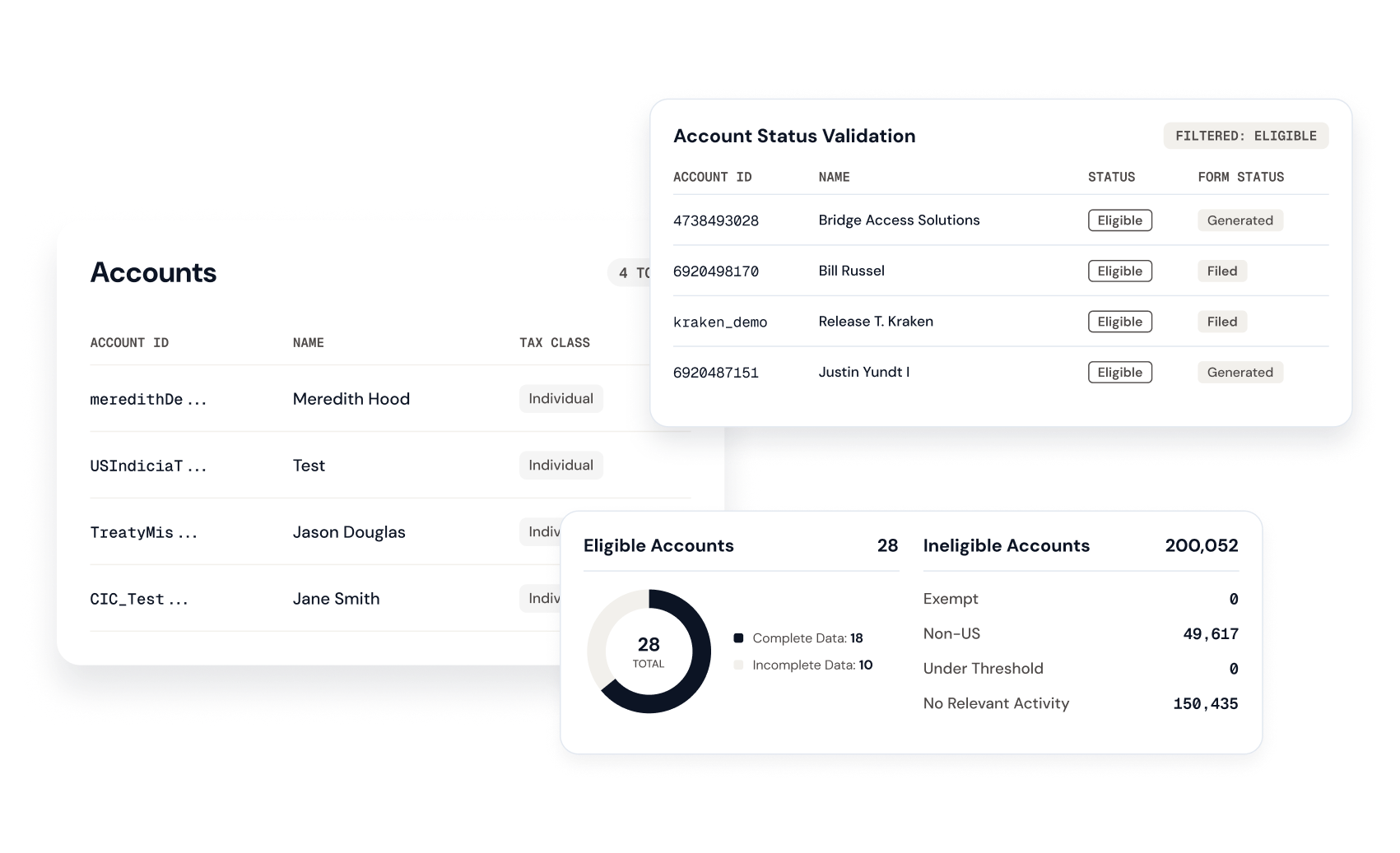
Cost basis and eligibility, account by account.
The obligation sits with the off-ramp
Stablecoin issuers have no reporting obligation. 1099-DA, CARF, and DAC8 attach at the exchange, wallet, or venue where a holder converts into fiat, another asset, or a different chain.
Cost basis has to survive the transfer
Each lot's cost basis carries its history across wallets, exchanges, and custody. Break that chain once when an asset changes hands, and the filed number is wrong.
Eligibility decided at the account level
Each account needs its own answer on who is reportable and under which regime, before any transaction is examined. That call has to run everywhere and hold up under review.
A framework that keeps moving
CARF and CRS 2.0 Wave 1 data collection is live in the EU, UK, Korea, Japan, and Brazil, and the Cayman Islands, with first filings due in 2027 for Tax Year 2026. DAC8 makes it EU law, and non-custodial 1099-DA follows in the US in 2027 on fixed deadlines.
By firm type
The hard part depends on where you sit.
The obligation usually has no owner. It lands on a one-person tax function, a product manager running tax season, or whoever sits closest to it.
US centralized brokers
You've filed a 1099-DA season, so the obligation isn't news. Next comes cost basis reporting on 2026 transactions and backup withholding, where the liability for tax not withheld sits with you rather than with your customer.
Non-US providers
Your KYC stack isn't this obligation. CARF and DAC8 require tax self-certifications and TINs that identity verification was never built to collect. They sit on top of KYC, with different data, rules, and legal basis. For a licensed firm, that gap is more than a filing problem.
The difference
Fragmented history in. Filed forms out.
The old way
- Cost basis rebuilt by hand every time an asset crosses a wallet, exchange, or custody boundary
- Reporting logic that treats every venue the same, issuer and off-ramp alike
- A separate build per regime as CARF, DAC8, and non-custodial 1099-DA phase in
- Wave 1 jurisdictions tracked in a spreadsheet instead of the system that files
With Taxbit
- Cost basis derived from raw transaction data, holding its history across every transfer
- Eligibility determined at the account level, the off-ramp identified, the rule cited
- 1099-DA, CARF, CRS 2.0, and DAC8 filed from the same source data
The brokers reporting through Taxbit.
“By automatically collecting information, remediating inaccuracies, and generating the required forms, we save companies and end-customers crucial time and significantly reduce operational costs.”
Edward Woodford · CEO & Founder, Zero Hash
AI you can put in front of a regulator
Rules written into the system make the call on every account, and your team can read them. Every action the AI proposes is reviewed by a person before it runs.
A full audit trail
Every gain and loss traces back to the transactions behind it.
Your data stays yours
Taxbit does not train AI models on your data, and nothing is sent to third-party AI vendors.
SOC 2 and enterprise controls
The security documentation your team asks for before a deal closes, ready for review.
Digital asset brokers, answered.
The call stops being one rule and becomes a per-account, per-instrument decision. A firm supporting spot, staking, derivatives, and stablecoin conversion has to work out which return each disposition belongs on, and in which tax year, before any form is generated. Taxbit derives that from your raw transaction data rather than asking you to pre-sort it, and every call can be re-run and traced back to the rule it came from.
For digital assets the answer is 1099-DA. Before the digital asset rules landed, brokers reported these dispositions on 1099-B, which is why the comparison still comes up, and 1099-B remains the return for traditional securities. Taxbit files 1099-DA, matching each account to the return and the jurisdiction it is reportable in, and shows the reasoning. When guidance changes, the update happens in the rules engine rather than in your team's mapping.
CARF applies to crypto-asset service providers that effect exchange transactions for customers, which covers most exchanges, brokers, wallet providers, and custodial platforms. In practice the hard parts are whether an entity is a Reporting Crypto-Asset Service Provider in each jurisdiction, which assets route to CARF rather than CRS 2.0, and how each jurisdiction's schema differs. Taxbit builds those calls into the rules engine and ships jurisdiction updates as configuration.
DAC8 brings crypto-asset reporting into EU law on the CARF data model, so a report filed with one member state is exchanged with the rest. For an exchange operating in several member states, the work is producing one reconcilable dataset and then meeting each state's filing format. Taxbit generates CARF and DAC8 from the same source data and files per-jurisdiction XML, so it is not a separate build per market.
Consistency breaks when basis is reconstructed after the fact from partial history. Taxbit derives full basis history from raw transaction data at the source, tracking transfers across wallets, exchanges, and custodians so the acquisition chain stays intact, and applies FIFO or specific identification per account. Every figure on the form traces back to the transaction it came from.
By validating at account opening rather than at year end. Taxbit matches US TINs against the IRS in real time and validates foreign tax IDs and VAT numbers by format when the account opens, and runs the same checks across an existing customer book so older accounts do not carry the risk forward. A TIN caught wrong at onboarding is a quick correction; the same TIN wrong after filing becomes a correction, a B-Notice, and penalty exposure.
Data has to arrive the way your stack already sends it, which form applies has to come from that raw data rather than a file you prepare by hand, and one audit trail has to survive the filing. Taxbit takes data in real time by API or SDK and in batches from Snowflake, S3, SFTP, or file upload, and you can re-run any call and see the rule behind it, from the first record to the filed return.