

Businesses operating within the digital asset ecosystem are likely hearing more about the Crypto-Asset Reporting Framework (CARF) and the amended Common Reporting Standard (CRS 2.0). While these information-reporting regimes are often referenced interchangeably, they are distinct in scope, applicability, and compliance obligations. Each framework covers different asset classes, applies to businesses under different criteria, and results in different reporting obligations and outcomes. Determining whether your business is subject to one or both regimes is essential to understanding your due diligence requirements and annual information return filing obligations.
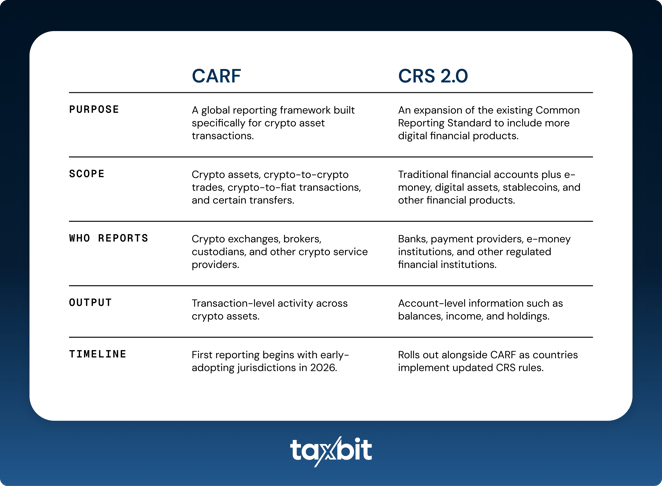
CARF is the global standard for reporting in-scope customer information and digital asset transactions. At a high level, if your business facilitates the exchange of digital assets for a customer, whether into fiat or into other digital assets, it will likely be required to report under CARF. Typical businesses that will fall into scope include:
Because CARF requires entirely new legislative infrastructure, jurisdictions are adopting it on different timelines. While over 75 jurisdictions have committed to implementing CARF, the most immediate action is required in Wave 1 jurisdictions. Wave 1 jurisdictions include all of the EU, and countries such as the UK, Japan, Korea, Brazil, and the Cayman Islands. For a jurisdiction-by-jurisdiction view of where CARF implementation stands, see our CARF Regulatory Tracker.
An important consideration is that if your business falls within scope of CARF, there are two immediate compliance actions:
The Common Reporting Standard (CRS) is an international framework developed by the OECD and approved in 2014. It requires and governs how financial institutions automatically collect and exchange account holder tax information across participating jurisdictions to help prevent global tax evasion. The CRS 2.0 update expands the scope to cover certain digital assets and financial products, including:
This expanded scope will likely pull in businesses that were not previously subject to a reporting obligation. For businesses that fall into scope for CARF, CRS 2.0 should be a top-of-mind consideration and determination.
CARF and CRS 2.0 operate on a distinct, asset-by-asset division of scope. For example, a regulated stablecoin is reported under CRS 2.0, while an unregulated one falls under CARF.
If your business offers a broad range of assets, it is important that you assess which regime is applicable. A likely outcome is that both CARF and CRS apply. It is important to understand that beyond the asset-level nuances, each regime has its own unique reporting requirements for customer activity. CARF requires transaction-level data aggregated by type and asset. That means potentially processing and consistently valuing millions of transactions.CRS 2.0 reports account balances and income.
Many digital asset businesses will fall into both regimes, especially where stablecoins or tokenised products are offered on the same platform alongside core digital assets. While these frameworks are intended to serve the same objective of global tax transparency, there are important differences in both the scope of data collection and the reporting requirements under each framework. Each of those steps varies by jurisdiction. What counts as a regulated stablecoin, for example, is decided country by country.
Taxbit enables and automates dual regime compliance in one platform.
Book a demo to see how it maps to your business.