Platforms that are obligated to document account holders, and file annual information returns could build the system themselves, but they should make that consideration with full knowledge of the upfront and ongoing costs.
What an in-house tax reporting system has to do
Whatever the regime, a reporting system needs to include a minimum of 5 foundational functions. Building it means your team owns all five in every regime you report under.
-
-
- Tax documentation: Collect, validate, and monitor critical tax documents, such as Forms W-9s, W-8s, or CARF/CRS self-certifications. Any time a change in circumstance occurs, the system must flag and ensure the customer is re-documented.
- Withholding: Based upon the classification of the customer and the type of payment, a reporting system must flag necessary withholding ahead of payments. In regimes such as CARF, the system must also provide indications of required account blocking.
- Data Validation: A reporting system must run extensive validations against customer data and transaction data. On the customer data, having global Tax ID matching functionality is a critical component ahead of reporting. On the transaction or payment side, the system must be able to classify the type of payment and run it through any additional analysis required of the applicable regime (i.e. cost basis in the U.S., or localized CARF rules globally).
- Reportability: decide which users and transactions are reportable under which regime.
- Filing: produce each regime's format, from IRS e-file to CARF XML, deliver recipient statements and handle corrections.
How much it costs to build tax reporting in-house
In our model, building in-house costs 2.0x–4.1x what buying does over three years, and the gap widens with every reporting framework you add.
What the model assumes:
-
-
- $66/hour for labor
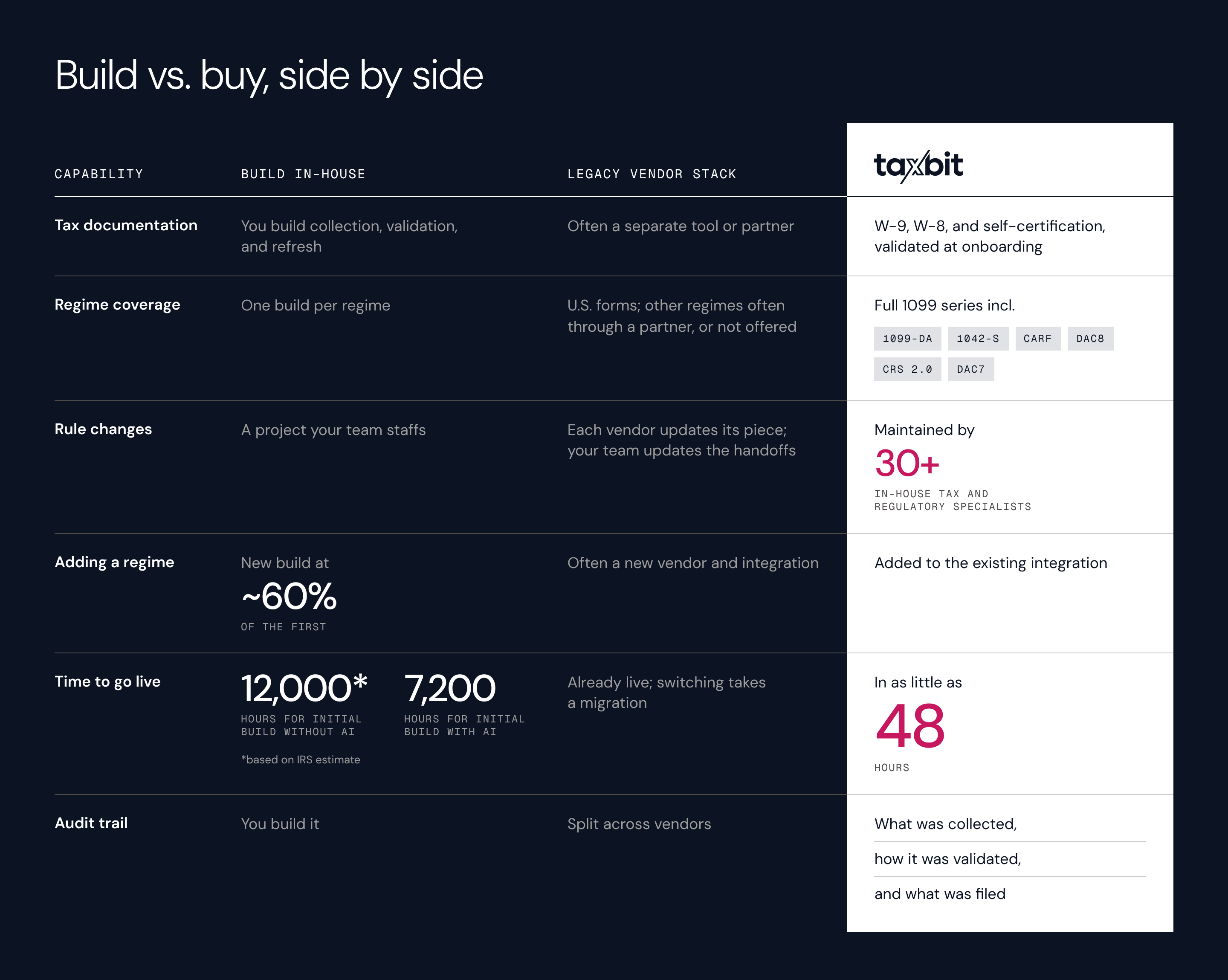
- 7,200 hours with the use of AI to build the first reporting framework
- 60% of that effort for each framework added
- Maintenance at 15% of build cost a year, before any rule changes
Most build estimates stop at launch
In our model, the initial build is less than half of the three-year cost, even for a U.S.-only platform. The rest is work that rarely makes the first estimate:
-
-
- Maintenance: 15% of the build cost every year, before a single rule changes.
- New markets: each framework after the first is another build at about 60% of the original effort.
- Tax documentation: every W-9, W-8, and self-certification has to be validated against KYC data, checked for the right TIN format by country, re-solicited when circumstances change, and chased when it’s missing or invalid, every cycle.
- Rule changes: each framework moves its schemas, thresholds, and deadlines on its own schedule, and every change is a project your team staffs.
- Advisors: outside experts to design the reporting logic, then re-validate it as the rules move.
- Data clean-up: manual reconciliation before every filing deadline.
- Audit questions: a homegrown system with no track record has to prove its logic from scratch.
What buying doesn't take off your plate
A vendor runs the reporting. Some of the work stays with you:
-
-
- Integration: your engineers map your data to the vendor's API and keep that mapping current.
- Data quality: a vendor files on the data you send. Gaps in your data are still your gaps.
- Roadmap: if you need something the vendor hasn't built, you're asking for it and waiting on the vendor's roadmap.
- Liability: penalty exposure stays with the filer whether you build or buy.
Run your own numbers
Our build vs. buy calculator runs the same model on your platform. Enter the regimes you'll report under in three years and your reporting volumes. It puts a three-year cost on building and on buying, with every assumption laid out so you can challenge it.
Run the build vs. buy calculator here