The Platform
Multiple regimes. One workflow.
One audit trail.
Fragmented tools get harder to manage as obligations grow. Taxbit unifies regulatory reporting and expert-built logic on one platform.

01
From raw data to filing
Ingest raw transaction data and produce the finished report, with no data-prep project required first.
02
One integration, many regimes
CARF, CRS 2.0, and local regimes on one stack, one data model, one audit trail. Normalized data teams can query, analyze, and build on.
03
Continuous, not annual
Ingest data year-round and catch errors early, so reporting doesn’t turn into an annual scramble.
Who this is for
Regulatory reporting affects more of your organization than most teams expect.
Here's where it hits first.
Compliance /
Operations
Operations
01
Owns onboarding, data quality, and reporting workflows across jurisdictions.
Click to see more →
Compliance / Operations
HOW WE HELP
✓Determine who is reportable by jurisdiction
✓Collect required reporting data in one workflow
✓Surface missing or invalid records before reporting
✓Generate submission-ready outputs with a clear audit trail
Click to close
Finance /
Controller
Controller
02
Relies on reconciled data and outputs the team can stand behind when deadlines hit.
Click to see more →
Finance / Controller
HOW WE HELP
✓Standardize reporting data in one system
✓Reduce year-end cleanup and manual reconciliation
✓Generate jurisdiction-specific reporting outputs
✓Improve confidence in reporting accuracy across the business
Click to close
Engineering /
Product
Product
03
Needs reporting infrastructure that fits the existing stack and without becoming a custom internal build.
Click to see more →
Engineering / Product
HOW WE HELP
✓Connect platform data through APIs or batch ingestion
✓Embed data collection into existing workflows
✓Support evolving local requirements without constant rebuilds
✓Give internal teams one maintained reporting workflow
Click to close
The companies regulators scrutinize most
already run on Taxbit

0M+
Tax forms filed
0B+
Digital asset transactions
0+
Reporting jurisdictions
Go deeper
Not ready to talk yet? Start here.
The detailed guides our customers use to scope CARF internally.
Common questions
The questions in-scope platforms are asking.
Plain answers on scope, coverage, and how the platform fits.
Which APAC & ME markets is Taxbit live in today? +
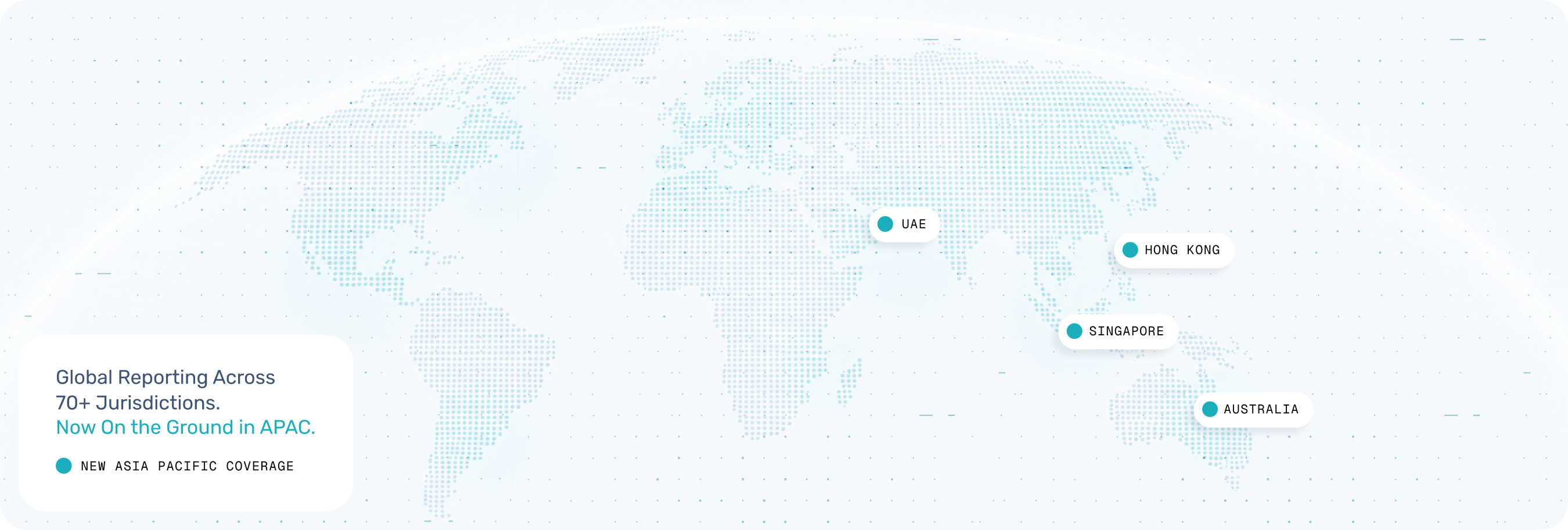
In APAC, Taxbit supports regulatory reporting across Singapore, Australia, New Zealand, the United Arab Emirates, and Hong Kong, with coverage expanding as jurisdictions publish new requirements. These sit within our broader global coverage of 70+ reporting jurisdictions.
Can we start with one framework and add jurisdictions over time? +
Yes. The platform is modular. Teams can start with CARF and CRS 2.0 and extend into jurisdiction-specific reporting requirements on the same platform as their operating footprint grows.
Do we need a MiCA or local license to be in scope? +
No. Licensing and reporting scope are determined separately. Whether a platform is in scope for CARF or CRS depends on the activity it performs, not on holding a specific license, so obligations can apply with or without one.
Not sure which applies to your platform? Talk to one of our CARF specialists
Does CARF apply only to crypto exchanges, or also to payment and fintech platforms? +
CARF scope is based on activity, not company type. It applies to any business that effectuates crypto-asset transactions for customers, which can include exchanges, custodians, brokers, and payment or fintech platforms that handle digital assets. A platform with no crypto-asset activity is generally outside CARF, though it may have obligations under other reporting regimes.
Not sure which applies to your platform? Talk to one of our CARF specialists
What is the difference between CARF and CRS 2.0, and which applies to our platform? +
CARF covers crypto-asset transactions at the transaction level. The amended CRS, often called CRS 2.0, covers financial account information and now extends to certain digital financial products, including some stablecoins and e-money tokens that fall outside CARF. Many platforms have obligations under both, and which applies depends on the products and services offered.
Read more: CARF and CRS 2.0: What's the difference?
How does Taxbit fit alongside our existing stack? +
Taxbit is API-first and connects to existing source systems through APIs and batch ingestion, with data collection embedded into current workflows rather than replacing them. Taxbit maintains the schema and jurisdiction-specific logic, so internal engineering does not have to re-implement rules as requirements change.