.png)


CRS 2.0 is an extension of the existing Common Reporting Standard (CRS). It expands the existing CRS scope to certain electronic money products, central bank digital currencies, regulated stablecoins, and indirect crypto exposure. CRS continues to be an annual exchange of account-level data and corresponding balances.
With the introduction of CARF and the widespread adoption of digital assets, companies must now determine whether they are subject to CARF, CRS 2.0, or both. This blog focuses on the additional data fields and reporting requirements associated with the CRS 2.0 extension.
The CRS 2.0 extension adds data points that require coordination across onboarding, KYC, product, account, and reporting systems.
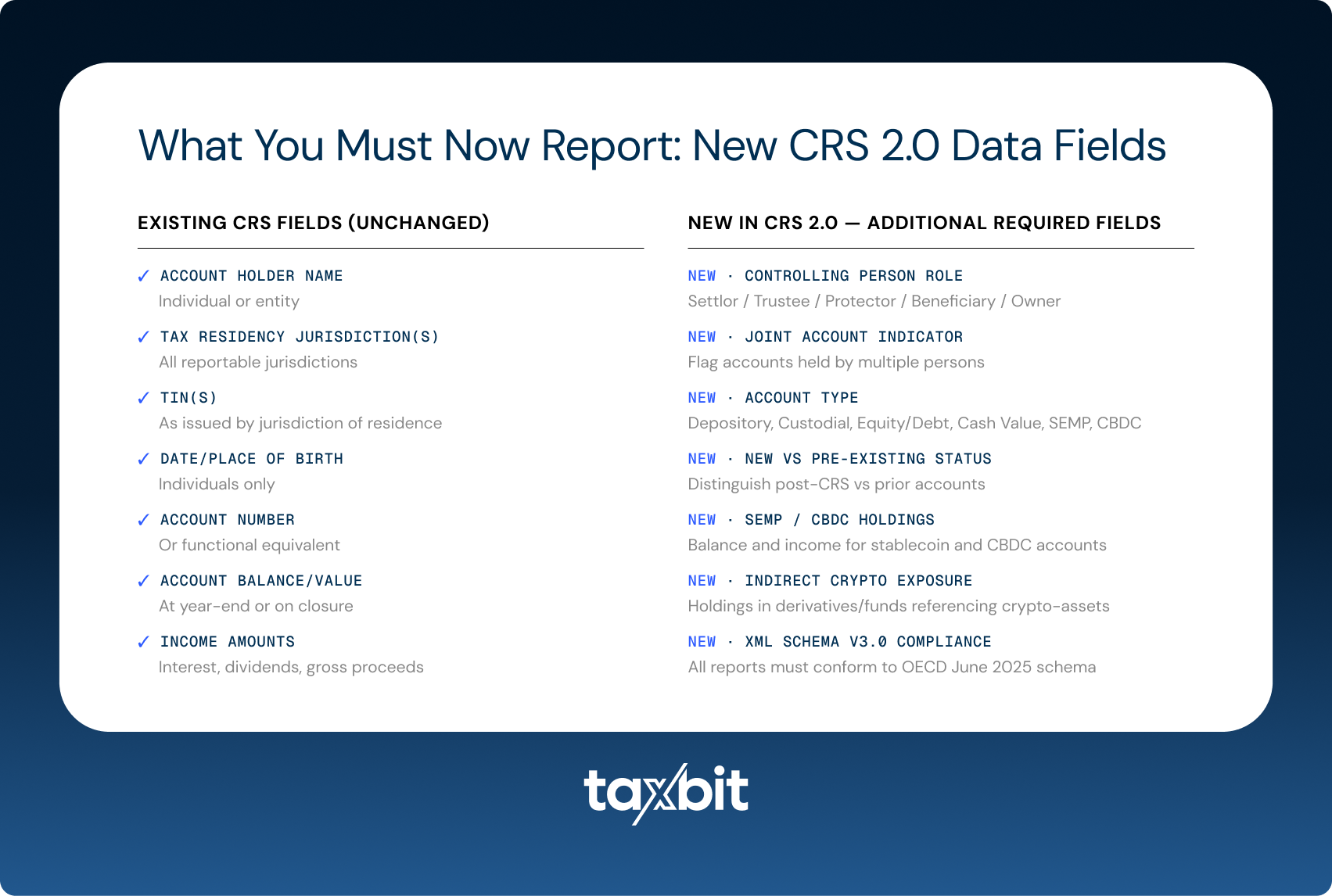
Companies must transform their internal operations from a once-a-year data collection exercise into a broader annual function that includes collection, analysis, and monitoring. Operational workflows need to actively link customer onboarding to ongoing account maintenance by validating that self-certification forms capture the newly mandated CRS 2.0 parameters upfront.
Because these additional fields depend on dynamic circumstances involving the account holder, assets, activity, and classifications, companies must establish robust data-monitoring processes. This ensures that any operational change in ownership or account structure automatically triggers a re-evaluation of the client’s classification, guaranteeing that final XML reporting outputs remain accurate, lineage-tracked, and audit-ready.
Because CRS 2.0 is implemented through domestic legislation across participating OECD jurisdictions, exact timelines depend on whether a country belongs to the First Wave or Second Wave adoption cohort. For First Wave jurisdictions, companies should be aware of the Self-Certification dates that generally were already in place, or commenced on January 1, 2026. The first wave of CRS 2.0 reporting will commence in early 2027.
No. CRS 2.0 is an extension of the existing CRS. It expands the scope of CRS to cover certain digital assets and financial products, while CRS reports account balances and income.
Not automatically. CRS 2.0 covers certain indirect crypto exposure, including derivatives and funds deriving investment income from digital assets. Direct digital asset activity may fall under CARF, depending on the asset, service, and jurisdiction.
A regulated stablecoin is reported under CRS 2.0, while an unregulated stablecoin falls under CARF. What counts as a regulated stablecoin is decided country by country.
Taxbit enables and automates dual-regime compliance in one platform.