


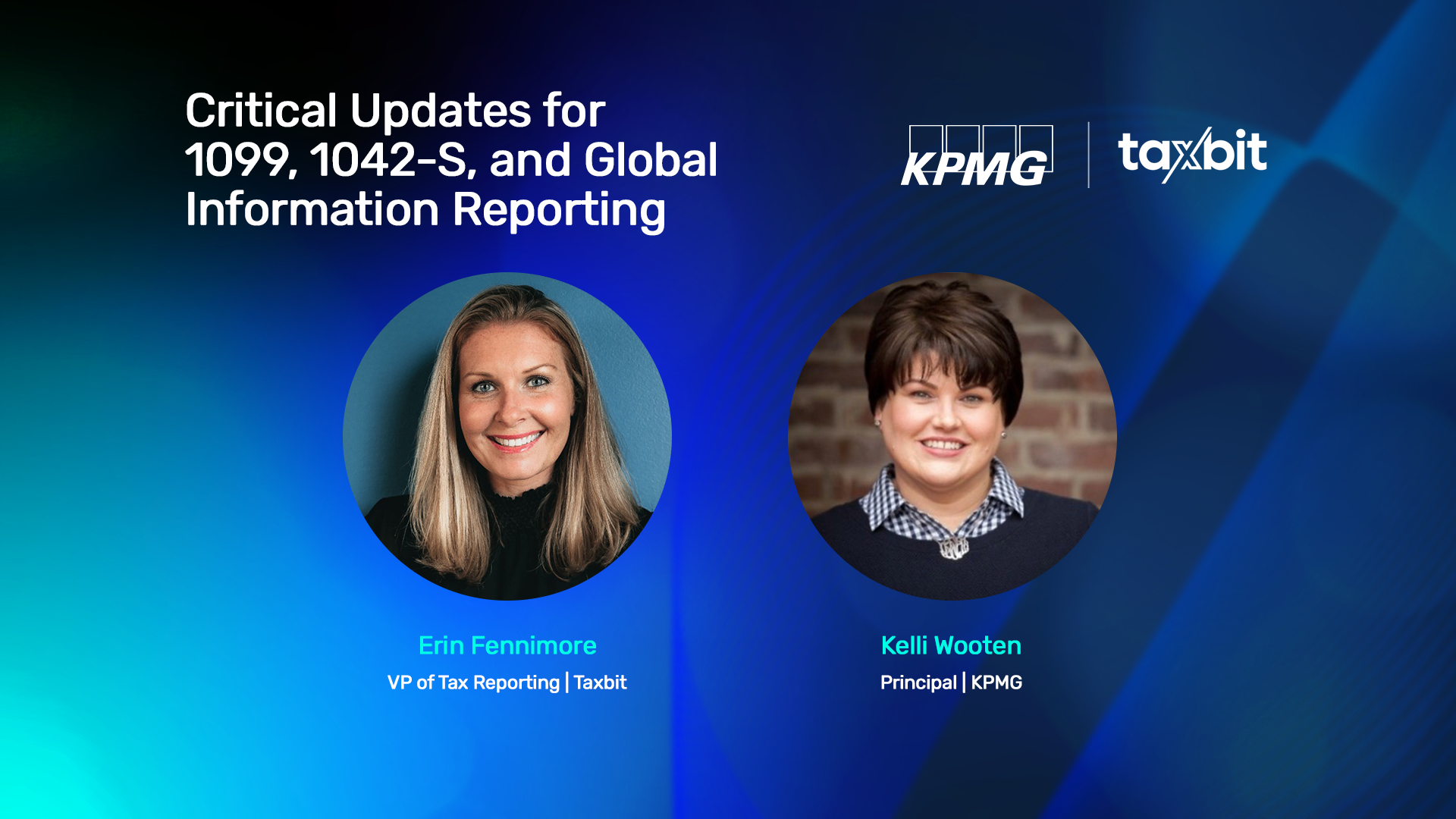
This on-demand webinar brings together industry leaders from KPMG and Taxbit for a practical, compliance-focused discussion on what’s changed, what’s coming next, and how to operationalize readiness across federal, state, and international reporting frameworks.
1099 Threshold Changes Are Evolving, But With Nuance: For tax year 2025, the $600 threshold remains for Forms 1099-NEC and 1099-MISC. Beginning in 2026, the threshold increases to $2,000 — with key exceptions for royalties and gross proceeds paid to attorneys. Backup withholding rules override thresholds entirely.
Form 1099-K Returns to a Two-Pronged Threshold: For 2025, reporting reverts to $20,000 and 200 transactions for third-party settlement organizations, while merchant acquiring entities remain subject to reporting without a minimum threshold.
Electronic Filing Is Now Mandatory for Many Filers: If filing more than 10 information returns in total, electronic filing is required. Organizations must secure a TCC and prepare for continued transition challenges from FIRE to the IRS’s IRIS system. Both U.S. and non-U.S. withholding agents must electronically file Form 1042 this year.
State Reporting Remains Fragmented: States maintain independent thresholds, schemas, and penalties. Not all participate in the Combined Federal State Filing Program, and Form 1099-DA is excluded for 2025. Certain states impose their own withholding-at-source rules and piggyback backup withholding requirements.
W-9, W-8, and TIN Matching Are Foundational Controls: Certified documentation and proactive IRS TIN matching significantly reduce B Notices and CP2100 risk. Bulk matching prior to filing season is a leading practice.
Extensions Require Strategy — Not Assumptions: Form 8809 provides an automatic 30-day extension for IRS filing (excluding automatic relief for 1099-NEC). The new Form 15397 governs recipient copy extensions. Form 1042 extensions allow six months, but estimated tax remains due by March 15.
Form 1099-DA Marks the Beginning of Digital Asset Reporting: Phase I (2025) requires gross proceeds reporting only, with good-faith penalty relief available. Cost basis reporting begins in Phase II (2026). The form is not included in the Combined Federal State Filing Program for 2025.
Global Reporting Regimes Are Expanding: The OECD’s Crypto-Asset Reporting Framework (CARF) and marketplace rules such as DAC7 and MRDP introduce jurisdiction-based XML reporting, self-certification requirements, and extraterritorial enforcement concepts. Documentation and onboarding processes in 2025 will directly impact 2027 reporting readiness.
Speakers
Kelli Wooten, Principal, KPMG
Erin Fennimore, VP of Tax Solutions, Taxbit
Related
1099, 1042-S, and the frameworks behind them, filed from one platform. Book a demo and bring a slice of your population.